Source Delta Robot for Food, Electronics, and Medical Packaging
Find 29 delta robot units from verified Chinese manufacturers offering customization, CE certification, and warranties up to 12 months. Compare specifications including payload, speed, and working range for applications in food, electronics, and medical packaging.
Key considerations
Products List




Comprehensive Sourcing Guide
Strategic Sourcing Guide for Delta Robots in Industrial Automation
Understanding Delta Robot Architecture and Core Specifications
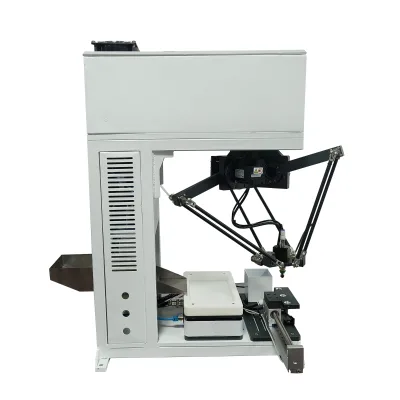
Delta robots, technically classified as parallel robot arms, represent a specialized class of automation equipment designed for high-speed pick-and-place operations. Unlike serial robots that utilize a chain of joints, delta robots employ a parallel kinematic structure where the end-effector is suspended by multiple arms connected to a fixed base. This architecture minimizes moving mass, allowing for exceptional acceleration and cycle rates that are critical in fast-paced production environments. When evaluating potential units, buyers must distinguish between different control modes, as the supplied data indicates a market offering both Point to Point Control and Continuous Path Control. Point to Point Control is typically sufficient for simple pick-and-place tasks where the robot moves from one coordinate to another without tracing a specific path in between. Conversely, Continuous Path Control is essential for applications requiring complex motion profiles, such as dispensing or precise assembly where the trajectory matters as much as the destination.
The physical capabilities of these units vary significantly based on the specific model series. For instance, the TFD-800 model is characterized by a working range width of 800mm or 1000mm, with a cycle rate capable of reaching 80 to 50 cycles per minute depending on the payload configuration. In contrast, other models in the TFD-RD2 Series or the YNT-A3Z series may offer different arm lengths, such as 800mm, 1200mm, or 1400mm, which directly influences the working envelope. The payload capacity is another critical specification, with observed ranges extending from 3kg up to a maximum of 12kg in specific configurations. The TFD-800, for example, lists a maximum payload of 10kg or 12kg, while other units in the market may support 3kg, 5kg, or 10kg. Buyers must verify the exact payload against their specific product weight, as the effective payload often decreases as the speed increases. The repeat positioning accuracy for these units is generally observed at ±0.1mm in the X, Y, and Z axes, a precision level that is standard for high-speed packaging but requires verification for applications demanding tighter tolerances.
Compliance, Certification, and Safety Standards
In the global B2B market, compliance with international safety and quality standards is non-negotiable. The primary certification observed in the current market data for these robotic systems is the CE mark. This certification indicates that the product meets the essential health, safety, and environmental protection requirements for products sold within the European Economic Area. While the presence of the CE mark is a strong indicator of compliance, buyers should not assume that all listed units automatically possess this status without explicit verification from the supplier. The certification process often involves rigorous testing of electrical safety, electromagnetic compatibility, and mechanical safety.
Beyond the CE mark, the safety features integrated into the robot design are paramount for operational security. Modern delta robots are frequently equipped with a comprehensive suite of safety mechanisms. These include safety mats that detect the presence of personnel near the work cell, safety light curtains that create an invisible barrier to stop the robot if breached, and emergency stop buttons for immediate power cutoff. Additionally, collision detection systems are increasingly common, allowing the robot to sense unexpected contact and halt operation to prevent damage to the unit or the product. The I/O interface is another area of compliance and integration importance, with some models offering an expandable 8-input/8-output configuration. This expandability allows for seamless integration with external safety devices and factory automation networks, ensuring that the robot can communicate effectively with the broader production line control systems.
Cost Drivers and Pricing Variables
The pricing structure for delta robots is influenced by a complex interplay of technical specifications, customization requirements, and logistical factors. The observed price range in the current market spans from approximately $2,000 to $98,550 USD. This wide variance is not arbitrary but is driven by specific hardware and service differentiators. The base price is heavily dependent on the payload capacity and the speed of the unit. A robot capable of handling 10kg at 120 cycles per minute will command a significantly higher price than a unit designed for 3kg at 50 cycles per minute. Furthermore, the control mode plays a role; units with Continuous Path Control capabilities often carry a premium over those limited to Point to Point Control due to the more sophisticated software and hardware required.
Customization is a major cost driver. The data confirms that customization is available for these units, with options for customized packing, such as wooden cases, wood boxes, or cartons, and even customized standard dimensions. The ability to tailor the arm length, payload, or specific I/O configurations adds to the engineering and manufacturing time, thereby increasing the unit cost. The brand name, such as "Unity," may also influence pricing, reflecting brand reputation and after-sales support structures. Additionally, the origin of the product, primarily noted as China with specific locations like Foshan or Linyin, Shandong, impacts the cost structure due to labor rates, material costs, and logistics. Buyers should be aware that while the initial purchase price is a significant factor, the total cost of ownership must also account for the warranty terms, which are typically 12 months or 1 year, and the availability of lifelong service support.
Typical Applications and Industry Suitability
Delta robots are uniquely suited for industries that require high-speed, repetitive handling of lightweight to medium-weight objects. The data highlights a diverse range of applications, including food packaging, electronics packaging, e-commerce packaging, automotive packaging, pharmaceutical packaging, cosmetic packaging, and metal or chemical industry processing. In the food and beverage sector, these robots excel at sorting, packing, and palletizing items where hygiene and speed are critical. The ability to handle payloads up to 10kg or 12kg makes them versatile for various product sizes, from small confectionery items to larger boxed goods.
In the electronics industry, the high precision of ±0.1mm and the ability to handle delicate components make delta robots ideal for placing circuit boards, assembling small electronic parts, and packaging finished goods. The e-commerce sector utilizes these robots for order fulfillment, where the high cycle rates of 80 to 120 times per minute are essential for meeting rapid shipping demands. The automotive industry employs them for handling parts, applying adhesives, or assembling components in a clean and efficient manner. The versatility of the application extends to the medical and chemical sectors, where the clean design and safety features prevent contamination and ensure operator safety. The installation method, often described as hoisting, allows for flexible integration into existing production lines, maximizing floor space utilization.
Supplier Evaluation and Quality Assurance
When selecting a supplier for delta robots, buyers must conduct a thorough evaluation based on the available data points. The condition of the product is consistently listed as "New," which is a baseline requirement for most industrial procurement. However, the reputation and reliability of the supplier are equally important. Buyers should verify the supplier's location, with noted origins in Foshan, China, and Linyin, Shandong, to assess logistics capabilities and potential lead times. The delivery time is observed to range from 10 to 25 work days, a factor that must be factored into production planning.
Quality assurance is another critical area. Suppliers should provide video outgoing-inspection services, allowing buyers to verify the condition and functionality of the unit before shipment. The packaging standards, ranging from wooden cases to cartons and plywood, must be robust enough to protect the robot during international shipping via land, sea, or air. The warranty terms, typically 12 months or 1 year, should be clearly defined, along with the scope of after-sales service, which includes lifelong support. Buyers should also inquire about the customization capabilities, ensuring that the supplier can meet specific requirements for arm length, payload, or control modes. The presence of a specific model number, such as TFD-800, TFD-RD2 Series, or YNT-A3Z, provides a reference point for technical support and spare parts availability.
Long-Term Procurement and Operational Considerations
Long-term procurement success with delta robots depends on more than just the initial purchase; it requires a strategic approach to maintenance, scalability, and integration. The cycle rate, which can reach up to 120 times per minute, places significant stress on the mechanical components. Buyers should consider the maintenance schedule and the availability of spare parts to ensure minimal downtime. The I/O interface expandability is a key feature for future-proofing, allowing the robot to adapt to new production requirements or additional safety devices without needing a complete system overhaul.
The color options and design features, such as the "New Design" noted in some listings, may also play a role in the aesthetic integration of the robot into the factory environment, though functionality remains the primary concern. The weight of the unit, observed at 62kg for some models, affects the structural requirements of the installation site. Buyers must ensure that the facility can support the weight and that the hoisting installation method is feasible within the existing infrastructure. Finally, the customization options for packing and standard dimensions should be leveraged to optimize the robot's fit within the specific workflow, ensuring that the investment yields maximum efficiency and return over the long term. By carefully analyzing these factors, buyers can make informed decisions that align with their operational goals and production demands.
FAQs
What customization options are available for delta robots?
Customization is available for these units, allowing buyers to tailor specifications. Options include customized packing such as wooden cases or cartons, and adjustable standard dimensions. Specific arm lengths and payload capacities can also be modified to meet unique production needs.
How long is the warranty period for these robots?
The warranty period is typically 12 months or 1 year for most models. Suppliers also provide lifelong service support alongside the standard warranty. This ensures long-term operational reliability and maintenance assistance for industrial automation systems.
Which certifications do delta robots typically hold?
The primary certification observed for these units is the CE mark. This indicates compliance with essential health, safety, and environmental protection requirements for the European Economic Area. Buyers should verify this status explicitly with suppliers before purchase.
What is the maximum payload capacity for these robots?
The maximum payload capacity ranges from 3kg up to 12kg depending on the specific model. For instance, the TFD-800 model supports up to 10kg or 12kg, while other units may handle 3kg or 5kg. Payload often decreases as speed increases.
How fast can delta robots operate in cycles per minute?
Cycle rates vary by configuration, reaching up to 120 times per minute for some models. Specific units like the TFD-800 operate at 80 or 50 cycles per minute depending on payload. High-speed operations are critical for fast-paced production environments.
Where are these delta robots manufactured and shipped from?
Products originate from China, with specific locations noted as Foshan and Linyin, Shandong. Shipping is available via land, sea, or air methods. Delivery times typically range from 10 to 25 work days after order confirmation.
What control modes are supported by these robotic systems?
The market offers both Point to Point Control and Continuous Path Control modes. Point to Point Control suits simple pick-and-place tasks, while Continuous Path Control is essential for complex motion profiles. The choice depends on the specific application requirements.
Can these robots be used for food and electronics packaging?
Yes, these robots are designed for applications including food, electronics, e-commerce, and automotive packaging. They handle lightweight to medium-weight objects with high precision. Safety features like collision detection ensure safe operation in diverse industrial environments.